Showing posts with label grade2. Show all posts

Sunday, June 26, 2016

Grade 2 - last entry

All the students work are to be sent home before the last day of school. There is a little activity booklet called "Viens à ma fête" which most students have not finished. It is encouraged that students  use the readings and activities in this booklet to consolidate their learning and practice reading over the summer.

If you have any questions, please contact me at extension 113.

I have truly enjoyed teaching Social Studies to Grade 2 students this school year. Thank you for all your support at home and for following this blog.

This blog will be re-purposed for the following school year.

Have a wonderful summer break.

Thursday, June 2, 2016

Grade 2 - Reminder and the end of year task.

Students have been talking about traditions and celebrations and how they change over time.

Some students still have not brought back their signed family tree rubric and the homework on their important celebration. Please send them back as soon as possible.

Many students are having difficult noticing differences between how their celebrations were celebrated in the past (by their parents or grandparents) and how they celebrate it now. It would be helpful to discuss with your child(ren) how immigrating to another country, speaking different languages, having different groceries and having new technologies have changed the way we celebrate different celebrations.

Students will be working on an interactive booklet where they will explain different aspects of their important celebration based on the homework they have completed at home.

Monday, May 16, 2016

Grade 2 - final project about a celebration

Students will be making a little interactive booklet on their most important celebration.

A paper copy of the following message will be sent out this week, along with a homework sheet.

----
Dear family,

In social studies, students have started looking at different celebrations and traditions in different families in our community.

On the homework sheet named “Les traditions et les célébrations chez moi!,” there are questions that students will have to complete with the help of their family members. Have your child(ren) explain the questions written in French. Should there be any difficulty, please visit my primary social studies blog (link below) for the English translation. Students must complete the work themselves through an interview with a family member who can help answer these questions about family celebrations and traditions. This work to be returned by 24th of May.


Thank you for your support.

-----

The following is the translation for the homework sheet.

A tradition is a belief, a custom, a habit or a practice that is passed on from parents to their children. The parents show these traditions orally or by doing it.

A celebration is a festival, feast or party that honours a person (e.g. Mothers day), a religious ceremony (e.g. Easter) or a special moment that happens during the course of the year (e.g. Canada Day).

1. What is your family's most important celebration?

2. What is the date of this celebration?
Does its date change every year? Circle yes no

3. For this celebration
We do / We eat / We wear / We meet

4. Why do you celebrate this celebration?

5. Did your grandparents and parents celebrate it (in the past) in the same way as you do? What are some of the similarities and differences?

6. What are some of your family's traditions?
(example / going out for dinner on Saturdays, spend a week every year at a cottage, going camping winter every winter, take a family picture every year, etc.)

Signature of the adult who helped.

Any questions, please send me an agenda note or call ext. 113.

Thank you very much for your support.

Mr. Jung


Sunday, April 10, 2016

Grade 2 - Comparing our families

We have been working on a Venn diagram to compare our family structure, origin and celebrations.

We are creating our family trees. Some students still have not brought in their photos and the worksheet to record all the names of their family members. Please  make sure that your child(ren) know(s) the full name of each member. Students are also encouraged to bring in the names written in the original language in addition to the names written with the Roman Alphabet.

Through this activity, students will be further compare the structure of their families and start discussing the countries of personal and familial significance.

Some ideas to support at home:
1. Locate the countries of personal and familial significance on the map.
2. Share the family albums and photos, especially those that depict the family traditions and celebrations to discuss how these practices have changed over time.
3. Discuss different family structures and origins of their friends and cousins and how these differences make each family unique.
4. Discuss local celebrations and how diversity in Canada brings many different people together to different celebrations.

Wednesday, March 23, 2016

Grade 2 - Mini-quiz

Late March - Early April

Students will have a mini assessment on identifying and describing different types of families using the vocabulary that we have discussed so far in term 2.

Students would benefit from reviewing the following post
http://jungrdps.blogspot.ca/2016/03/grade-2-different-types-of-family.html

or the handout with the same texts with images that was given out to be kept in their Social Studies duotang.

Thank you for your support.

Thursday, March 10, 2016

Grade 2 - Family Tree handout help

Here is the English translation of the handout in case there is any confusion or difficulty understanding the sheet. Your child should be able to explain it to you and conduct an interview with you to fill it in himself/herself.

Where do I come from?                                                                DUE : 29th of March 2016

1. My complete name
2. Brother(s) or stepbrother(s)
3. Sisters or stepsister(s)
4. My (step)mother’s name
Her family is from…
5. The (step)father of my (step)mother
6. The (step)mother of my (step)mother
7. My (step)father’s name
His family is from…
8. The (step)father of my (step)father
9. The (step)mother of my (step)father
10. Other family members that I want to include in my tree

Signature of the adult who helped


Thank you for your support.


Grade 2 - Family Tree Project Letter

This letter is to be sent out on the 10th and 11th of March.

Dear families,

We will be making a family tree in class. Your child will need to bring in pictures of different family members and/or extended family members. We just need a picture of the head of the person. The head should not be much bigger than about 1 1/2 inch (about passport size), otherwise the people will not fit on the poster, especially when there are many people in your family. Please, do not cut up the pictures, but be prepared that your child will cut it up at school, so send a copy of the picture if you don't want it to be destroyed. Your child should know these people. If you have too many just send in the favorite ones. You might want to label the back of the picture if your child cannot remember the names of the persons. Please put all the pictures in an envelope with your child's name on it and send it in with your child. If you do not have a photograph of your family member, your child can draw a picture of that person. Students will not be penalized for not bringing pictures in.

Also, please take time to complete the handout “D’où est-ce que je viens?” with your child, where students are asked to record the names and the origin of their family members and/or extended family members.

The due date for the pictures and the handout is 29th of March for every grade 2 student. Please DO NOT MAKE A FAMILY TREE! The children will be making it in class.

If you have any question about this project, please contact me (ext. 113). Thank you for your support.


Mr. Jung

Sunday, March 6, 2016

Grade 2 - Different types of family

We are learning to identify and describe different family structures and origin.

Qu'est-ce qu'une famille?
Une famille est le lie où l'enfant se sent aimé par les adultes qui en prennent soin.

Une famille monoparental : il y a un parent qui élève les enfants.
Une famille nucléaire : il y a deux parents qui élèvent les enfants.
Une famille sans enfants : il y a deux adultes qui habitent ensemble sans enfants.
Une famille dirigée par les grands-parants : les grands-parents élèvent leurs petits-enfants au lieu des parents biologiques.
Une famille homoparentale : il y a deux adultes du même sexe qui élèvent les enfants.
Une famille multigénérationnelle : Cette famille est créée quand les membres d'une famille habitent ensemble. Souvent ça inclus des cousins, tantes, oncles ainsi que des grands-parents.
Une famille recomposée : Cette famille est créée quand deux adultes, avec des enfants d'une autre relation, déménagent ensemble.
Une famille immigrée : Cette famille habite dans un pays qui n'est pas leur pays de naissance.
Une famille d'accueil : Cette famille prend soin d'enfants qui ont besoin de vivre dans un endroit différent de celui de leurs parents pour une période indéterminée.

Have students identify the type of their own family, a friend's family, a cousin's family, etc.


Wednesday, February 3, 2016

Grade 2 - End of the Term and the next unit.

During the second term, we will be working on our Heritage and Identity : Changing Family and Traditions unit (For the curriculum information click here and view page 76-81). Please check this blog frequently for updates on how you could support your child(ren) at home during this new unit.

Thursday, January 7, 2016

Grade 2 - The country project and extra activities for support

Students have started a project on a country. Please discuss with your child(ren) which country they have chosen and ask why they chose it, what they know about it already, and what they want to know more about it. Students will be doing a research online on a Chromebook to learn more about it over the next couple of weeks. Students are expected to be able to:
- Locate the country on the world map. (in which hemisphere? in which continent?)
- Demonstrate understanding of differences between continents and countries.
- Ask questions about its population, food, climate and animals (and more) and answer to those questions through research.
- Use a website to find information about it (www.cyber-flag.net) - capital, currency, language, etc. to complete a report.
- Use a Venn diagram to compare their country with another.


Some extra practice activities to help students achieve the curriculum expectations:
1. Open the following page and look at the weather in different parts of the world. Why are they different? http://www.meteomedia.com/ Choose a country and make a prediction about the weather and look it up on this website to check if their prediction was correct.

2. Play geography games to locate different countries. Use a world map to help. Especially the games under "pays du monde"
http://www.jeux-geographiques.com/jeux-en-ligne-Tous-nos-jeux-MONDE-_pageid168.html

3. Watch videos about lives of different children around the world. Discuss why we have different houses, food, traditions, clothes, etc. and how they are related to their natural environment.
http://laoujedors.com/

Friday, December 11, 2015

Grade 2 - Quiz #1 answers and audio/translation.

Question 1
Les continents

Les océans
L’Afrique
 E

L’Océan Pacifique
 1
L’Asie
 D

L’Océan Indien
 4
L’Europe
 C

L’Océan Antarctique
 5
L’Antarctique
 G

L’Océan Atlantique
 2
L’Australie / L’Océanie
 F

L’Océan Arctique
 3
L’Amérique du Nord
 A


L’Amérique du Sud
 B


Question 2

Question 3
E Le nom de l’océan qui se trouve à l’est de l’Amérique du Nord.
D Le nom de l’océan qui se trouve à l’ouest de l’Amérique du Sud.
C Le nom du continent qui se trouve au sud de l’Amérique du Nord.
F Le nom du continent qui se trouve au nord de l’Afrique.
E Un grand espace plein d'eau salée qui couvre 70% de la surface de la Terre.
G Un grande espace de terrain à la surface de la Terre.
A Une ligne imaginaire qui sépare la Terre en deux parties horizontalement. Elle marque la séparation entre l'hémisphère nord et l'hémisphère sud.
H Une ligne imaginaire qui sépare la Terre en deux parties verticalement. Elle marque la séparation entre l'hémisphère ouest et l'hémisphère est.

Click here for translation and audio for the question 3. Click on the speaker icon for pronunciation. Long click to play it slowly.

Sunday, November 29, 2015

Grade 2 - World map

The quiz will be sent home during the week of 11-30. Please review the quiz with your child, sign and return.

To further support your child(ren):
Review the handouts given in class including the vocabulary sheets.

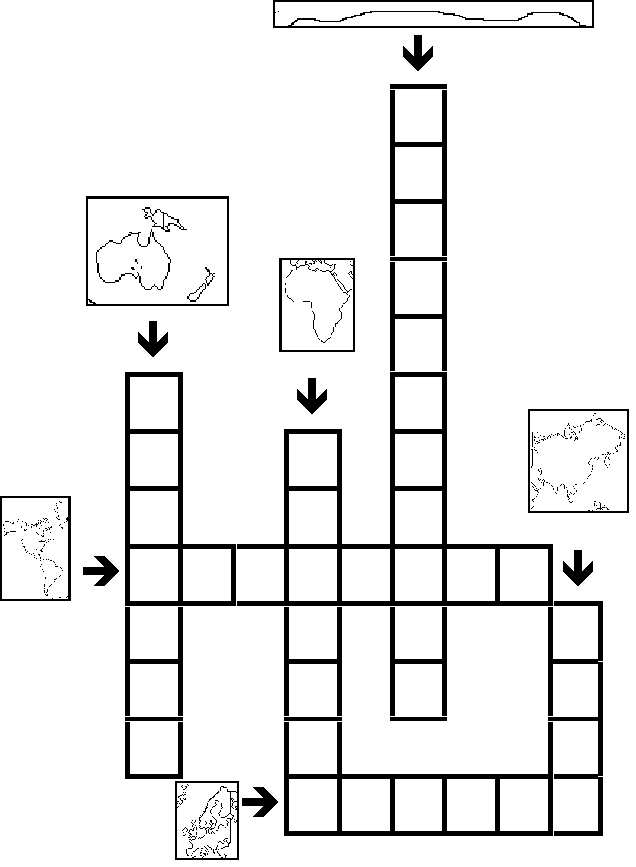
Printable activities to review continents and oceans
http://www.anglaisfacile.com/cgi2/myexam/images2/64543.gif
http://i.imgur.com/a94wKl.jpg
http://www.professeurphifix.net/eveil/mots_croises_continents.gif

Game to review continents and oceans
http://serbal.pntic.mec.es/ealg0027/mmundi1f.html
http://www.jeux-geographie.fr/oceans.html
http://www.jeux-geographie.fr/continents.html

Print mega-size maps to walk on them
http://www.yourchildlearns.com/megamaps.htm

Google Earth
http://www.google.com/earth/explore/products/

Thursday, November 26, 2015

Winter Concert Song for the primary students

Winter Concert song for all primary students (grade 1-3) 


Bonjour l’hiver
Bonjour l’hiver
Et comment ça va?
Je suis content(e) que tu sois avec moi.

Bonjour l’hiver
Tu te portes  bien
Reste un peu avec nous autres               
Chantons un refrain.

Ah, tes glaçons brillants,
Suspendus au toit,
Tes  flocons de neige
Qui dansent autour de moi

Allons patiner
Glisser en traîneau
Je suis content(e)  quand tu arrives
Dans notre petit hameau.

Charlotte Diamond

https://www.youtube.com/watch?v=lEINdfUmxsQ

Sunday, November 15, 2015

Welcome to Primary Social Studies Blog

Welcome! It is my pleasure to teach your child(ren) Social Studies this school year 2015-2016.

I will be posting important updates, announcements, homework and extra materials for primary Social Studies (Grade 1-3) on this blog. I greatly appreciate your support for child(ren)'s progress in Social Studies at home.

To view only grade 1 posts:

To view only grade 2 posts:

To view only grade 3 pots:

This blog is not meant for parent-teacher communication. No comment or email sent via this blog will be read or answered. If you have any general questions or would like to discuss your child(ren)'s progress in Social Studies, please call extension 113 or send a note in your child(ren)'s agenda/communication envelop for an appointment. Thank you for your cooperation.

Best,

Mr. Jung